Best Resume Screening Software for Staffing Agencies
A practical guide to choosing resume screening software for staffing agencies that need faster, more consistent review and clearer client shortlists.
Resume Selector TeamSep 17, 202613 min read
Staffing agencies screen resumes in a different context from most internal recruiting teams. A recruiter is often balancing several open jobs, client preferences, candidate relationships, submission deadlines, and a desk full of partial information. The best resume screening software for that work does more than search a database for keywords. It helps the recruiter apply a consistent role brief, capture evidence, see where information is missing, and explain a shortlist to a client.
This guide covers focused screening tools and staffing ATS/CRM platforms. They solve related but different problems. A focused tool can improve first-pass review and shortlist preparation. A staffing platform can connect those activities with client, job, candidate, submission, sales, and placement operations.
For a closer look at the practical handoff, see how to build candidate shortlist reports that give clients evidence and follow-up questions instead of a raw stack of resumes.
Quick answer
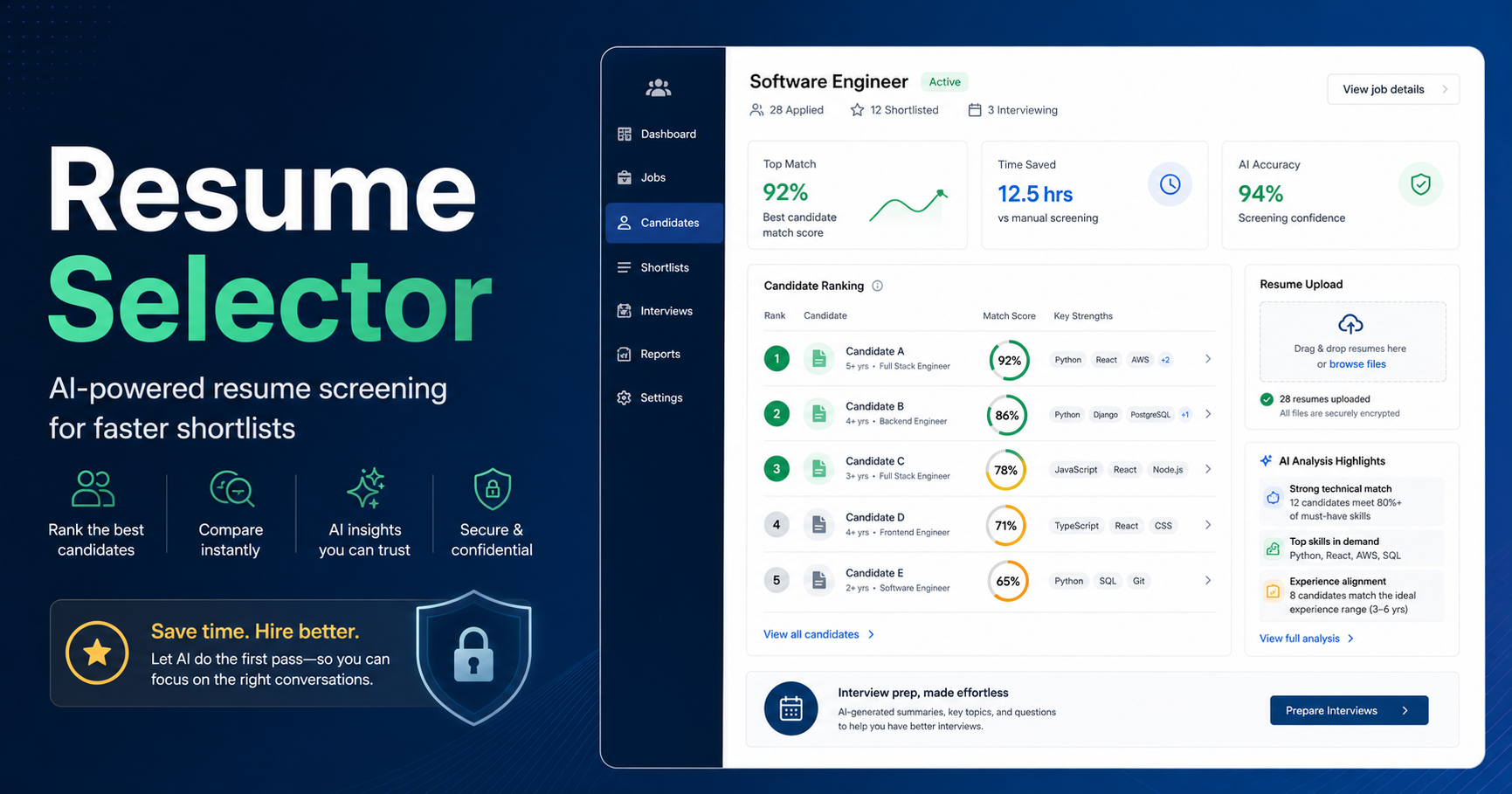
If the immediate challenge is creating a structured, explainable shortlist from a resume batch, Resume Selector is a focused option for criteria-based evaluation, candidate comparison, interview questions, and shortlist reports. It is built as AI-assisted screening with the recruiter in control.
If your staffing firm needs a core system for the whole desk, look first at staffing ATS/CRM products such as , , , , , , or . The best fit will depend on your specialty, client workflow, sales process, integrations, reporting needs, and administrative capacity.
Do not choose from a marketing demo alone. Test a current job order and a small anonymized resume batch. The vendor should be able to show how the role requirements are recorded, how candidate evidence is viewed, how a recruiter can override or add context, and how a client-facing submission is prepared.
Recruiter reviews all analysis and decides next steps
Bullhorn
Established staffing businesses with broader operating needs
Staffing ATS/CRM and connected recruiting operations
Scope of rollout, integrations, configuration, and total cost
Recruiters manage submissions and candidate status
JobAdder
Agency desks seeking an ATS/CRM foundation
Jobs, candidates, clients, pipeline and agency workflow
Whether its data model matches your desk and client process
Recruiters control workflow decisions
Vincere
Recruitment and staffing firms needing agency workflow
ATS/CRM and operational workflow for recruiting businesses
Regional needs, implementation support, and reporting
Users control candidate movement and submissions
Loxo
Agencies that value sourcing and recruiting workflow in one product
ATS/CRM, sourcing-related workflow and candidate engagement tools
Data quality, sourcing workflow, and client portal needs
Recruiter owns shortlist and outreach decisions
Recruit CRM
Small and midsize staffing firms seeking ATS plus CRM
Candidate and client records, pipelines, outreach and automation
Automation governance and custom-field setup
Users set rules and take candidate actions
Zoho Recruit
Configurable agency recruiting operations
Custom fields, workflows, automation and database organization
Admin ownership and plan-specific functionality
Recruiters configure and review the process
Manatal
Agencies wanting agency-oriented ATS/CRM
Candidate sourcing, CRM and pipeline management
Integration, export, permissions and reporting needs
Recruiters decide candidate disposition
Feature availability and pricing vary by plan, region, and contract. Treat the table as a buying framework, then validate your required workflows directly with each vendor.
Methodology: what staffing agencies should evaluate
We assessed these products using the practical work of a staffing recruiter rather than a generic software checklist. A useful system should help a recruiter answer five questions for every submission:
What did the client say is required for this job?
What resume or recruiter evidence supports the candidate’s fit?
What is unclear, missing, or worth verifying before submission?
How does this candidate compare with the other available people for the same job?
Can the recruiter explain the recommendation later, after the desk has moved on to the next urgent role?
We also considered whether a product is intended to be a screening layer or a staffing operating system. Neither category is inherently better. A focused tool may be easier to introduce for a particular bottleneck. A full ATS/CRM may offer more value when duplicated data, client activity, and placement process are the larger problems.
One important rule applies to every option: do not ask software to make a final hiring or rejection decision. Candidate evaluation includes context that a resume cannot reliably settle, including transferable experience, project ownership, availability, communication, and the client’s changing priorities. The recruiter should review the underlying evidence and own the recommendation.
1. Resume Selector
Resume Selector is an AI-assisted resume screening product aimed at making first-round review and shortlisting more structured. The recruiter starts from a job description and criteria, then reviews candidate analysis rather than only scanning files one at a time. The product supports criteria-based evaluation, explainable candidate scoring, side-by-side comparison, interview question generation, and shortlist report generation.
That combination is useful for staffing agencies when the operational system already exists but the review process is inconsistent. One recruiter may produce excellent submission notes while another sends raw resumes. A shared way to record role evidence, missing information, and suggested questions gives the team a more repeatable starting point.
Best for: staffing recruiters who want to structure a resume batch and build clearer client shortlists without replacing their ATS or CRM.
Why it stands out: its focus is the gap between incoming resumes and a recruiter-owned shortlist. Scores are accompanied by explanations so the recruiter can see the basis for the output and correct the conclusion with their own judgment.
Keep in mind: it does not replace placement tracking, client relationship management, payroll, or the many operational capabilities a staffing platform may provide. It works best when the agency has defined the role criteria before screening begins.
2. Bullhorn
Bullhorn is a familiar name in staffing technology and is commonly evaluated as a staffing ATS/CRM platform. For agencies with a mature desk process, its appeal is the ability to centralize candidate, job, client, and recruiting activity rather than treat screening as an isolated task.
Best for: staffing firms that need a substantial central platform and have the resources to configure and maintain it.
What to test: take a real job order from intake to submission. Check how the system stores mandatory versus preferred requirements, captures recruiter notes, finds prior candidates, and produces a client-ready submission. Ask how integrations and data migration will affect daily work.
Potential tradeoff: the strength of a broad platform can also make it a larger implementation commitment. A small firm should account for administrator time, change management, and the likelihood that recruiters will use the intended fields consistently.
3. JobAdder
JobAdder is designed around staffing and recruitment agency workflow, combining ATS and CRM-style functions. Agencies may consider it when they want candidate and client activity, jobs, tasks, and recruiting processes in a shared workspace.
Best for: recruiting agencies that need core agency workflow across recruiting and client management.
What to test: create a representative job, import several candidate records, log a conversation, prepare a submission, and find it again later. Ask whether recruiters can distinguish a verified requirement from a resume claim that needs follow-up.
Potential tradeoff: do not assume the default workflow is your workflow. Confirm the amount of customization, integration work, and ongoing administration your team will need.
4. Vincere
Vincere is another product that staffing and recruitment businesses may evaluate for integrated ATS and CRM workflow. A platform in this category can be especially relevant for firms that want recruiting, client development, and operational visibility to work from related records rather than disconnected tools.
For screening, look beyond search and keyword matching. The recruiter needs to preserve the reason a candidate was considered for a particular job. A platform is more useful when that context is easy to record, retrieve, and include in a submission or handoff.
Best for: agencies that want an agency-specific operating system with connected recruiting and CRM processes.
What to test: your real handoff points. Can a recruiter pass an urgent role to a colleague without losing the client’s must-haves, candidate evidence, and outstanding questions? Can a manager inspect a submission history without reconstructing it from emails?
Potential tradeoff: implementation needs vary by agency process and connected systems. Confirm reporting, localization, integration, and support requirements for your market before treating feature lists as a final answer.
5. Loxo
Loxo is often considered by agencies that want recruiting workflow and sourcing-related capabilities together. Its appeal is to make candidate discovery, engagement, and ATS/CRM process less disconnected. That may be valuable for desks where the best submission is not always in the new-applicant pile.
Best for: agencies that combine active sourcing with agency ATS/CRM workflow.
What to test: source-to-submission workflow. Ask to see how a sourced profile becomes a job-specific candidate, how a recruiter records evidence and consent-related operational details as appropriate, and how the team prevents duplicates or stale information from muddying a shortlist.
Potential tradeoff: confirm data-source, outreach, and integration terms separately from the core ATS experience. Those details often have more effect on an agency’s daily process than an attractive candidate search screen.
6. Recruit CRM
Recruit CRM combines ATS and CRM concepts for recruiting and staffing teams. For a smaller firm, that combination can be attractive because it keeps client and candidate work close together without immediately adopting a heavyweight enterprise platform.
The practical benefit is coordination. A recruiter can work from a job, candidate record, pipeline stage, and client context in the same system. Its usefulness for screening will depend on whether your team makes role-specific notes part of the standard submission process.
Best for: small and midsize agencies that want an accessible ATS/CRM and are prepared to define their own processes.
What to test: take a difficult profile, not only an obvious match. Can you record that the candidate has adjacent experience, identify what needs a screening call, and show a client a balanced submission note? That is a better test than a keyword search demo.
Potential tradeoff: automation can be useful for routine reminders and updates, but review any rule that changes candidate status or sends outward-facing communication. The team should understand what the automation does and retain an easy way to intervene.
7. Zoho Recruit
Zoho Recruit offers recruiting workflow with configurable fields, forms, and automation. Its flexibility can appeal to an agency that has unusual desk practices or already uses the wider Zoho ecosystem.
The best use of configuration is to reflect a process the team has agreed on. For example, a role record might separate must-have experience, preferred background, rate or availability questions, and client-specific interview concerns. That structure gives the resume review a reference point. It is more valuable than adding many custom fields simply because the product allows it.
Best for: agencies that want a configurable system and have an owner for setup and ongoing governance.
What to test: build one job scorecard, review a small candidate batch, and report on it. Check whether the data is still understandable to a new recruiter or hiring manager after a few weeks.
Potential tradeoff: flexibility comes with setup work. Confirm plan limits, integrations, reporting, and administrative permissions before assuming a configuration can be maintained easily.
8. Manatal
Manatal is an agency-oriented ATS/CRM option with candidate sourcing and pipeline management capabilities. It may appeal to firms that want a modern recruiting workspace with tools for organizing candidate and client activity.
For staffing agencies, the fundamental test is whether the system makes the desk more deliberate. The system should help a recruiter identify why a profile is relevant to this job now, not simply indicate that the profile appeared in a search result.
Best for: small and midsize agencies looking for an ATS/CRM centered on recruiting operations.
What to test: candidate comparison and client submission. Ask a recruiter to review three people with overlapping backgrounds and articulate the difference in evidence, not just the difference in a ranking.
Potential tradeoff: validate integration, permission, export, and reporting needs early. Those are especially important when client data, recruiters, and managers work across multiple desks.
A practical selection process for staffing agencies
Use a two-week evaluation plan instead of trying to score every vendor feature. First, pick one repeatable role. Define required, preferred, and clarification criteria with the client or account manager. Then use the same anonymized resume batch in each product demonstration.
Give every vendor these tasks:
Capture the job order and screening criteria.
Add five candidates with varied but plausible backgrounds.
Show the evidence for each required criterion.
Flag missing or unclear information for recruiter review, rather than treating it as a final outcome.
Compare the top three profiles.
Create a client submission or shortlist report.
Show how the recruiter records a final decision and reason.
Score the output with the people who actually screen and submit candidates. A finance or operations leader may reasonably care about integrations and reporting. The recruiter should decide whether the system makes a busy morning easier or adds fields nobody will maintain.
If the role brief is still vague, draft a candidate scorecard before scheduling vendor demonstrations. It gives the evaluation team the same reference point for every test.
FAQ
What is the difference between a staffing ATS and resume screening software?
A staffing ATS usually manages candidates, jobs, clients, pipeline stages, and related recruiting operations. Resume screening software focuses on evaluating resumes against a role, comparing candidates, and preparing a shortlist. An agency can use either category alone or combine them.
Should staffing agencies use AI to rank candidates?
AI-assisted scoring can help organize a first review if the criteria and explanation are visible. It should not be treated as a final ranking or automatic disposition. Recruiters should inspect the resume evidence, consider context, and decide what happens next.
What belongs in a client submission note?
Include the role requirements the candidate appears to meet, specific supporting evidence, points to confirm, availability or process details where appropriate, and suggested interview topics. Avoid presenting unverified resume claims as facts.
Can the same screening scorecard work for every client?
Use a reusable structure, not a universal scorecard. Most agencies benefit from separating required criteria, preferred criteria, evidence, risks, and open questions. The content of those categories should be tailored to each job and client brief.
What is the first thing to automate in a staffing workflow?
Start with repetitive administration that is easy to inspect, such as organizing candidate details, reminders, or draft summaries. Keep human review for candidate qualification, client submissions, and decisions that materially affect someone’s opportunity.
Conclusion
The best resume screening software for a staffing agency is the system that helps recruiters make a clearer case for each submission. That may be a staffing ATS/CRM when the agency needs an operational foundation. It may be a focused screening layer when the urgent problem is first-pass consistency and shortlist preparation.
Bullhorn, JobAdder, Vincere, Loxo, Recruit CRM, Zoho Recruit, and Manatal each deserve a workflow-based evaluation if you need agency operations in one place. Resume Selector is designed for the screening stage: structure the criteria, review the evidence, compare candidates, prepare questions, and send a more useful shortlist. In every case, the recruiter remains accountable for the recommendation.
Structure your next staffing shortlist with Resume Selector
If your team wants a more consistent first review before a client submission, compare Resume Selector plans or try a role with a clear scorecard. Resume Selector helps turn candidate evidence into comparisons, interview questions, and shortlist reports while keeping the recruiter in control.