AI Resume Screening: A Practical Guide for HR Teams
Learn how AI resume screening helps recruiters review resumes faster, compare candidates consistently, and keep humans in control of hiring decisions.
AI resume screening is most valuable when it solves a clear recruiting pain: Manual resume review becomes slow and inconsistent as soon as a role receives more qualified applications than a recruiter can read carefully in one sitting.
For HR teams, recruiters, and hiring managers, the goal is not to let software make the hiring decision. The goal is to create a faster, more consistent first-pass review so humans can spend more time on judgment, candidate conversations, and hiring manager alignment. Resume Selector is built around that idea: AI assists with extraction, evidence, scoring, and interview preparation while recruiters stay responsible for the final decision.
Why teams search for AI resume screening
The search intent behind this topic is usually to understand how AI resume screening works before choosing a tool. That means the right solution should be practical, explainable, and close to the day-to-day hiring workflow. A recruiter should be able to understand why a candidate was recommended, what evidence was found, and which questions still need human review.
The best outcome is simple: A structured first-pass review that extracts candidate evidence, compares it with the job brief, and helps recruiters focus their time on judgment.
When this workflow helps
- screening a large applicant pool for a new opening
- standardizing how different recruiters evaluate the same role
- preparing a clear shortlist for hiring managers
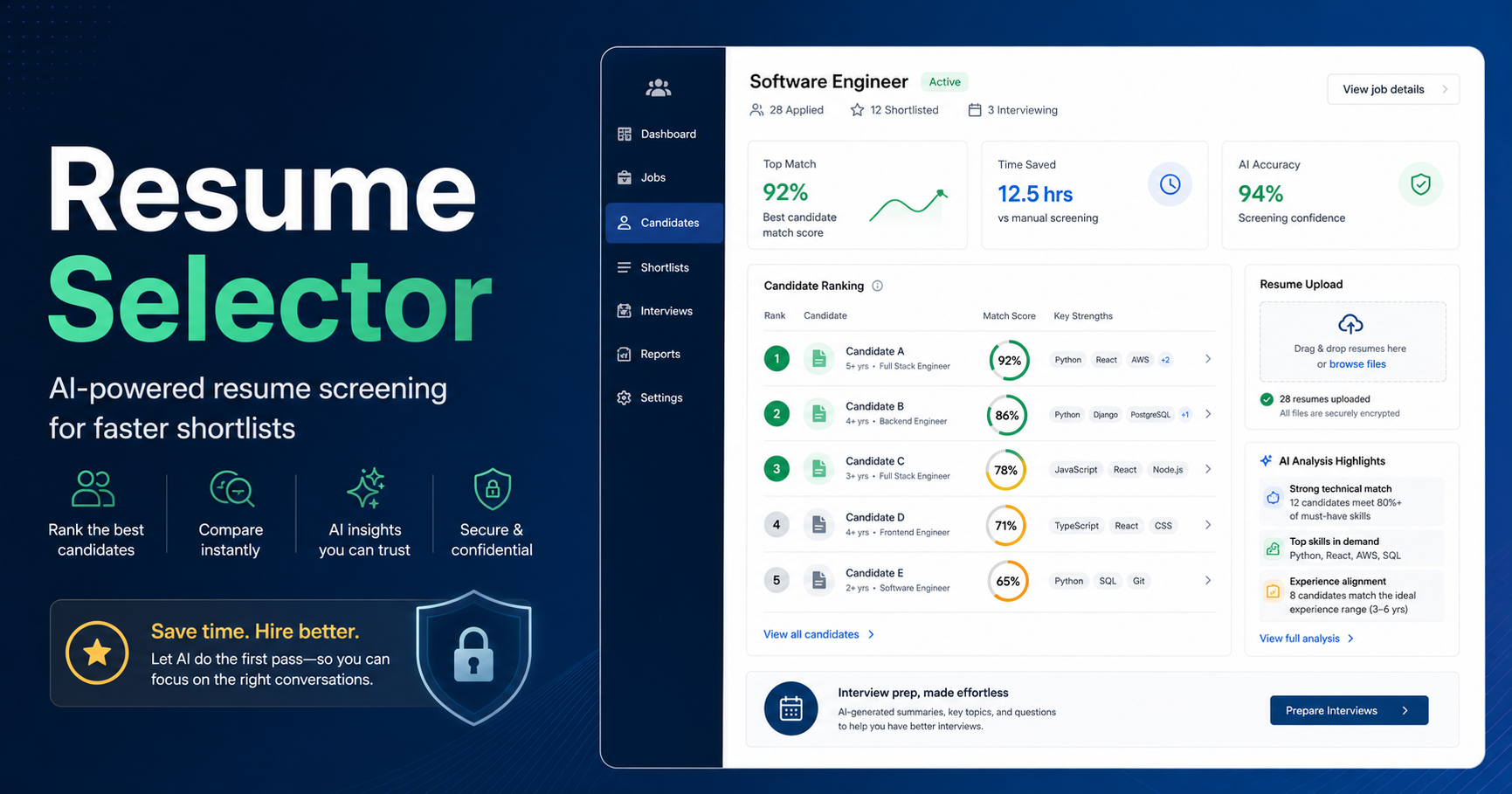
These situations have the same operational problem. Candidate information is trapped inside different resume formats, and the team needs a fair way to compare people against one role. Resume Selector turns that unstructured information into candidate summaries, score breakdowns, missing-skill lists, evidence maps, statuses, and hiring reports.
Recommended workflow
- Start with a detailed job description and separate must-have skills from nice-to-have skills.
- Upload resumes in batches and let the system extract skills, experience, education, links, and missing information.
- Review score justifications and evidence before moving candidates to a shortlist.
- Use generated interview questions to verify claims instead of treating the score as a final decision.
This workflow keeps the recruiter in control. AI reduces repetitive reading and note preparation, but the recruiter still checks the evidence, changes candidate status, adds feedback, and decides which profiles move forward.
What to check before trusting the output
- The tool explains why a candidate matches or misses each requirement.
- Recruiters can override statuses and add feedback.
- The final hiring decision stays with the team.
- Sensitive or protected characteristics are not used for recommendations.
If a tool cannot explain its recommendation, it should not be used as the basis for a hiring action. Recruiters need transparent reasoning, especially when a candidate has transferable experience, a non-linear background, or an incomplete resume.
Common mistakes to avoid
- Using AI scores without reading the evidence.
- Uploading vague job descriptions and expecting accurate ranking.
- Treating resume screening as a replacement for structured interviews.
Avoiding these mistakes is what separates useful recruiting automation from shallow keyword matching. The strongest process combines structured AI output with recruiter review and hiring manager calibration.
Metrics to monitor
- time to first shortlist
- percentage of resumes needing manual review
- candidate score consistency
Measure the process before and after introducing AI assistance. The most useful recruiting metrics are tied to real workflow improvements: faster first review, clearer shortlists, better interview preparation, and fewer avoidable back-and-forth conversations with hiring managers.
How Resume Selector supports this
Resume Selector helps teams create a recruitment, define job requirements, upload resumes, analyze candidates, compare profiles, and generate reports. It is designed for HR teams, recruiters, and hiring managers that need speed without hiding the reasoning behind candidate recommendations.
For a broader foundation, read the related guide on candidate shortlist software. Together, these workflows help recruiting teams move from manual resume reading to evidence-based shortlisting without giving up human judgment.